How do I get an appointment?
Our service is open to families who are registered with a Lambeth or Southwark GP.
If you're concerned about your child, talk to one of the following professionals who will be able to make a referral for you:
- your health visitor
- your child's nursery teacher or school teacher
- your GP
- your child’s other health professionals e.g. therapists
Learn more about our referral process.
Arranging your child’s appointment
Once referred and accepted, we will call you to arrange an appointment. If we can’t reach you, we will send a letter asking you and the person who referred you to contact us. If we don’t hear from you, your child’s referral may be closed.
Most first appointments happen in person at one of our Child Development Centres: Mary Sheridan Centre in Lambeth or Sunshine House in Southwark.
Please check your appointment letter to make sure you go to the right child health centre.
Before the appointment
Please fill out and return any forms we send you. This helps us make the most of your appointment. We usually ask your child’s school or nursery to fill out a form about how your child is doing there too.
Please let your child know why they will be coming to see us and go through this information with them so they know what to expect.
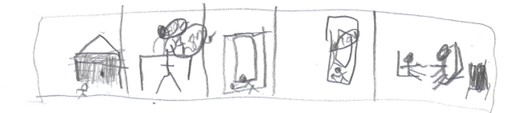
Here is a 5 year old child’s explanation (and drawing) of what will happen when you arrive!
- First you get to the building.
- Then the person at the desk with a computer says hello.
- Then you find somewhere to sit in the waiting room.
- Then I found the play room! That’s all the toys.
- Then the doctor (or another team member) said my name and we went to another room to talk.
 What to bring to your child’s appointment
- Your child’s red book (health record), if you have it
- Any recent reports from schools, therapists or specialists
- Videos taken from home of any unusual movements or behaviours in particular that you want to discuss
When you arrive for your child’s appointment
Please check in at reception when you arrive so we know you are here. If you are running late, please let us know by calling:
Mary Sheridan Centre: 020 3049 5967
Sunshine House: 020 3049 8100
Our waiting areas have toys and books available, as well as access to small gardens or soft play areas that you are welcome to use. You’ll also find a range of health information leaflets, which you are free to browse or take home.
Toilets and water fountains are available for your convenience. If you have any questions while you wait, please don’t hesitate to speak to a member of our reception team. The health professional you are seeing will call your name and collect you from the waiting room.
What happens during a developmental assessment?
A developmental assessment helps us understand your child's development, identify their strengths and any areas where they may need extra support, and decide what the best next steps are.
During the appointment, the clinician may:
- Ask questions about your child's development, health and family history.
- Talk through any concerns you, your child’s school or nursery, or other professionals may have.
- Spend time observing your child through play, conversation and activities.
- Carry out a physical examination if needed.
- Review information from school, nursery and other professionals involved in your child's care.
- Discuss their findings with you and explain any recommendations or next steps.
Many developmental assessments can be completed in a single appointment, while some children may need further assessment or information gathering before conclusions can be reached. Please see the range of clinics that we offer for more details.
After the appointment
Stickers are always available to any child who would like one, please feel free to ask if we forget to offer.
Possible outcomes of the assessment
Every child is different, so the outcome of the assessment will depend on your child's needs, age and the information available at the time of the appointment.
Possible outcomes include:
- No significant developmental concerns are identified and no further follow-up is needed.
- A period of monitoring, with advice and support provided.
- Further assessments or information gathering to help us better understand your child's needs.
- Referral to another service, such as therapy services or specialist teams.
- Referral onto a specialist assessment pathway where appropriate, for example in one of our other clinics
- A diagnosis being made and a support plan agreed with you.
Whatever the outcome, we will explain our findings, discuss any recommendations with you, and provide a written report after the appointment. We will share this report with you, your child’s GP and the person who referred your child. With your permission, we can also share it with your child’s school or other professionals who support your child.
Language support
If you need an interpreter, please tell us which language you speak. We can arrange for an interpreter to be with you for your appointment. If you need help before your appointment, or if an in-person interpreter isn’t available, we can also arrange for a phone interpreter to assist you.
Changing or cancelling your appointment
If you can’t come, please call us as soon as you can to reschedule.
Mary Sheridan Centre: 020 3049 5967
Sunshine House: 020 3049 8100
If you don’t arrive for your appointment, we will try to contact you by calling the telephone numbers on your child’s health record. If we cannot get through to you and you didn’t call to cancel the appointment in advance, we may assume you don’t need our service anymore and your child may be taken off the waiting list.